26 June — 7 July 2026 · 4 travellers

Tanzania

A field guide to four travellers, twelve days,
and one extraordinary country.

days
hours
min
sec
01 — At a glance

Quick facts

The trip in twelve numbers. Skim before you fly.

12
days on the ground
4
travellers
4
national parks
Tarangire · Lake Manyara · Serengeti · Ngorongoro
2
coastlines
Indian Ocean · Lake Victoria adjacent
5
degrees south of the equator
it’s dry season — sunny, cool mornings
+3
hours UTC
no daylight saving
TSH
Tanzanian shilling
~2,500 TSH ≈ 1 USD · USD widely accepted
G
plug type
UK three-pin · 230 V
SW
Swahili & English
both are official
5,895
m — Kilimanjaro
Africa’s highest peak (we’ll only admire from afar)
2M+
wildebeest in the Migration
June–July: northern Serengeti crossings begin
stars at night
no light pollution in the parks
02 — Logistics

Trip admin

The boring-but-essential. Keep this open at the airport.

Documents

  • Passport (valid 6+ months past return, with 2 blank pages)
  • Tanzania e-visa or visa on arrival — visa.immigration.go.tz
  • Yellow Fever certificate (only if arriving from a YF-endemic country — verify your route)
  • Travel insurance card + policy number
  • Driver’s licence (in case you rent a scooter on Zanzibar)
  • Printed copies of e-visa, hotels, safari voucher

Money

  • Bring USD cash (post-2009 bills, crisp, no marks) for tips, park exit fees, small purchases.
  • ATMs in Arusha, Stone Town, Zanzibar resorts dispense TSH — Visa works most reliably.
  • Notify your bank of travel dates before departure.
  • Tipping safari crew (industry standard): ~$10 / person / day for the guide, ~$5 / day for the cook on camping nights. Hand to lead guide on the last day in an envelope.
  • Stone Town & Zanzibar hotels: 10 % service is usually included; round up otherwise.

The four of us

Originally five — one had to cancel. Final headcount: 4.

  • 26 Jun – 5 Jul: all four together (Zanzibar + safari)
  • 6 Jul morning: two depart from Kilimanjaro
  • 6 Jul: remaining two — Materuni Waterfalls & coffee plantation day trip from Arusha
  • 7 Jul: remaining two depart

Booking confirmed for 4 pax with Lucas. The original quote PDF still shows 5 — that document didn’t get reissued, but the actual reservation is correct.

Key contacts

Lucas African Adventures (safari operator)
+255 78 546 8021 · +255 746 026 914 (WhatsApp)
info@lucasafricanadventures.com
Ref. #2026-0227.4 · Lucas Kimambo
Emergency — Tanzania
112 (police / general) · 114 (ambulance) · 115 (fire)
AMREF Flying Doctors
+254 20 6992000 — air evacuation, worth noting if you’re deep in a park

Connectivity

  • SIM: grab a Vodacom or Airtel SIM at the airport — passport required, takes ~10 min, ~$10 for a generous data bundle.
  • eSIM: Airalo / Holafly work in Tanzania if you’d rather skip the queue.
  • Wi-Fi: reliable at Stone Town hotels and Furaha Lodge; flaky-to-absent in Serengeti and Ngorongoro camps.
  • Download offline Google Maps for Zanzibar & Arusha; download Spotify / Netflix offline for the long drives.

Daypack essentials

  • Reusable water bottle (camps refill)
  • Binoculars (8×42 is the safari sweet spot)
  • Camera + spare battery + dust cloth
  • Sunscreen SPF 50 · lip balm · sunglasses · wide-brim hat
  • Light buff/scarf — dust on game drives is real
  • Power bank (camps don’t always have power outside meal hours)
  • Small headlamp (Ngorongoro Simba campsite)
03 — Day by day

The itinerary

Four days of Zanzibar on our own terms. Six days with Lucas across the Northern Circuit. Two days for the slow goodbye.

Lake Victoria Indian Ocean Zanzibar Zanzibar · Stone Town 26 — 29 Jun Arusha 30 Jun · 5 — 7 Jul Tarangire Serengeti 1 — 2 Jul Ngorongoro Materuni · 6 Jul
Route — Zanzibar by the sea, then the Northern Circuit by land cruiser, then a quiet coffee farm to close.
  1. 26 Jun Fri

    Zanzibar — arrival & breath

    Stone Town & the south-east coast

    Land in Zanzibar, taxi to the hotel, wash off the flight. First swim. First sunset. The four of us, finally.

    independent beach unstructured
  2. 27JunSat

    Stone Town & spice

    Stone Town · spice farm

    Walk Stone Town in the cooler morning — Old Fort, House of Wonders façade, the Anglican Cathedral built on the old slave market. A spice tour in the afternoon: cardamom, cloves, lemongrass, vanilla. Dinner at Forodhani Gardens — the night market, grilled seafood, sugarcane juice.

    history UNESCO spices
  3. 28JunSun

    Ocean day

    Mnemba atoll / Nungwi / Kendwa — pick one

    Snorkel on Mnemba (turtles, parrotfish), or surf-flop on the powder-white beaches of the north. Sundowner at the Rock — book ahead.

    snorkeling dhow pole pole
  4. 29JunMon

    Last Indian-Ocean day

    Stone Town

    Pack early. Buy kanga & coffee & small things to take home. Lunch at Lukmaan or Emerson on Hurumzi rooftop. Repack into safari bags — soft duffel only for the safari, the suitcase stays in Arusha.

    repack souvenirs
  5. 30JunTue
    Safari · Day 1

    Tarangire & Lake Manyara

    Arusha → Tarangire NP → Furaha Luxury Lodge

    Morning flight Zanzibar → Kilimanjaro. Lucas’s team meets us in Arusha. Transfer south to Tarangire — the park of the elephants and the baobabs. Afternoon game drive looking for lion and elephant. Sundowner. Then a night drive in Lake Manyara — an unusual privilege; most parks don’t allow it.

    • Stay: Furaha Luxury Lodge — 1× double, 1× triple (adjust to 2× double for 4 pax)
    • Meals: lunch & dinner
    • Look for: elephants, baobab trees, leopard in the trees, possibly nocturnal genets & civets on the night drive
  6. 01JulWed
    Safari · Day 2

    Into the Serengeti

    Furaha → Serengeti NP → Mbuni Serengeti Camp

    Long transfer with a game drive built in. Cross into the Serengeti — the name comes from Maasai Siringet, “the place where the land runs on forever.” Afternoon game drive on the central plains.

    • Stay: Mbuni Serengeti Camp (tented)
    • Meals: breakfast, lunch & dinner
    • Look for: cheetah on the kopjes, lion prides, giraffe under acacias, the great migration’s leading edge
  7. 02JulThu
    Safari · Day 3 · Balloon

    Above the Serengeti at dawn

    Mbuni Serengeti Camp

    Hot-air balloon at first light. Pickup is around 04:30 — coffee in the dark, then up over the savannah as the sun comes through. Champagne breakfast in the bush after landing. Full-day game drive through the central Serengeti afterwards.

    • Stay: Mbuni Serengeti Camp
    • Meals: all included (champagne breakfast in the bush)
    • Tip: long sleeves & long trousers for the balloon — the burner is hot above your head, the air is cool below
  8. 03JulFri
    Safari · Day 4 · Walking

    Ngorongoro Highlands

    Serengeti → Ngorongoro Simba Campsite

    Early-morning game drive in the Serengeti before leaving — cooler, better light, animals more active. Then up into the highlands. Walking safari with an armed ranger — a different scale of seeing. Camp tonight is on the rim of the crater. Cold night — bring layers.

    • Stay: Ngorongoro Simba Campsite (bush camp on the rim)
    • Meals: breakfast, lunch & dinner
    • Bring up tonight: headlamp, fleece, beanie, hot-water bottle if you have one
  9. 04JulSat
    Safari · Day 5 · The Crater

    Down into Ngorongoro

    Crater floor → Furaha Luxury Lodge

    The descent into the crater is the kind of moment people remember for life. 260 km² of intact ecosystem, 600 m below the rim. Black rhino, lion prides, flamingo on the soda lake, hippo in the marsh. Up and out by mid-afternoon back to Furaha for hot showers and a real bed.

    • Stay: Furaha Luxury Lodge
    • Meals: all included
    • Look for: the elusive black rhino — Ngorongoro is one of the few reliable places on Earth to see one
  10. 05JulSun
    Safari · Day 6 · Maasai

    Maasai village & back to Arusha

    Furaha → Maasai Village → Arusha

    Cultural visit to a Maasai manyatta — songs, the jumping dance (adumu), inside the boma. Be a guest, not a tourist; ask before photos. Drive back to Arusha. Safari ends.

    • Meals: breakfast & lunch
    • Tip: tipping envelope to the lead guide today
  11. 06JulMon

    The four become two

    Arusha · Materuni

    Two depart in the morning — Kilimanjaro Airport, ~1 hr from Arusha, allow buffer for traffic and check-in.

    Two stay for a Materuni day: ~1.5 hr drive to Materuni Waterfalls on the southern slopes of Kilimanjaro. Short forest hike to the 80-m falls, swim if you’re brave (it’s cold). Lunch at the village. Coffee tour at a Chagga family farm — pick the cherries, roast on the fire, pound the beans, drink the result.

    waterfall coffee tour Chagga culture
  12. 07JulTue

    Kwaheri, Tanzania

    Kilimanjaro / JRO

    The remaining two depart. Twelve days, four parks, two coastlines, and a great deal of red dust on the boots.

04 — Field guide

What we’re looking for

A small bestiary of the Northern Circuit, with notes on where each one tends to show up.

The Big Five

A 19th-century hunting term for the five animals hardest to take on foot. Now a checklist of awe.

Lion Simba

Where: Serengeti kopjes (rocky outcrops they sun on), Tarangire’s long grass, the Ngorongoro crater floor.

Listen at dusk for the deep contact roar — it carries five miles.

Leopard Chui

Where: in trees. Look for a tail dangling from a horizontal acacia branch in Tarangire and the central Serengeti.

The hardest of the Big Five to spot. Solitary, nocturnal, master of camouflage.

Elephant Tembo

Where: Tarangire is the elephant park — herds of 50+ around the Tarangire river. Also Ngorongoro forest.

Matriarchal society. The oldest cow leads. Trumpet, low rumble, gentle ear flap — a whole language.

Buffalo Nyati

Where: everywhere there is grass and water. Big herds in the Serengeti and on the Ngorongoro crater floor.

The most dangerous of the Big Five to humans on foot. Don’t mistake their stillness for placidity.

Black Rhino Faru

Where: Ngorongoro Crater is the place. Maybe 40 individuals on the entire crater floor — the only reliable sighting in the country.

Critically endangered. Tanzania has fewer than 200. Watching one graze feels like time travel.

Also keep an eye out for…

Cheetah Duma — Serengeti plains; look on termite mounds for the silhouette at scanning height.
Giraffe Twiga — Tanzania’s national animal. The Maasai giraffe (with the jagged-edge spots) is endemic to the region.
Hippo Kiboko — Hippo Pool in central Serengeti, Lake Manyara’s shallows.
Wildebeest Nyumbu — In late June / early July the leading edge of the migration is in the northern Serengeti, edging toward the Mara River.
Zebra Punda Milia — “striped donkey.” The migration’s outriders.
Hyena Fisi — Spotted hyena are everywhere; their giggle on a Ngorongoro night is unforgettable.
Crocodile Mamba — Mara River crossings (later in the season), Tarangire river bends.
Flamingo Heroe — Lake Manyara & Ngorongoro’s soda lake, in pink ribbons along the shore.
Lilac-breasted roller — Tanzania’s prettiest bird and the easiest to identify mid-flight.
Secretary bird — long-legged snake hunter, walks the Serengeti grass with a quill-like crest.

The Great Migration in late June / early July

Two million wildebeest, 200,000 zebra, 500,000 gazelle. By June the herds have reached the western corridor and are pushing north. By early July the leading edge is at the Grumeti and approaching the Mara — though the famous Mara crossings tend to peak in July–August. Our window catches the build-up: huge concentrations on the central and northern plains.

05 — The land

Tanzania, briefly

A country of plateaus and great lakes, of seventeen-million-year-old fault systems and 7th-century trading ports. Here are the parts that matter for what we’ll see.

Geography

Tanzania sits where East Africa folds. The Great Rift Valley runs through it twice — the eastern arm ripped open Lake Manyara and the soda pan of Ngorongoro 2.5 million years ago, when one of the world’s largest volcanoes collapsed in on itself.

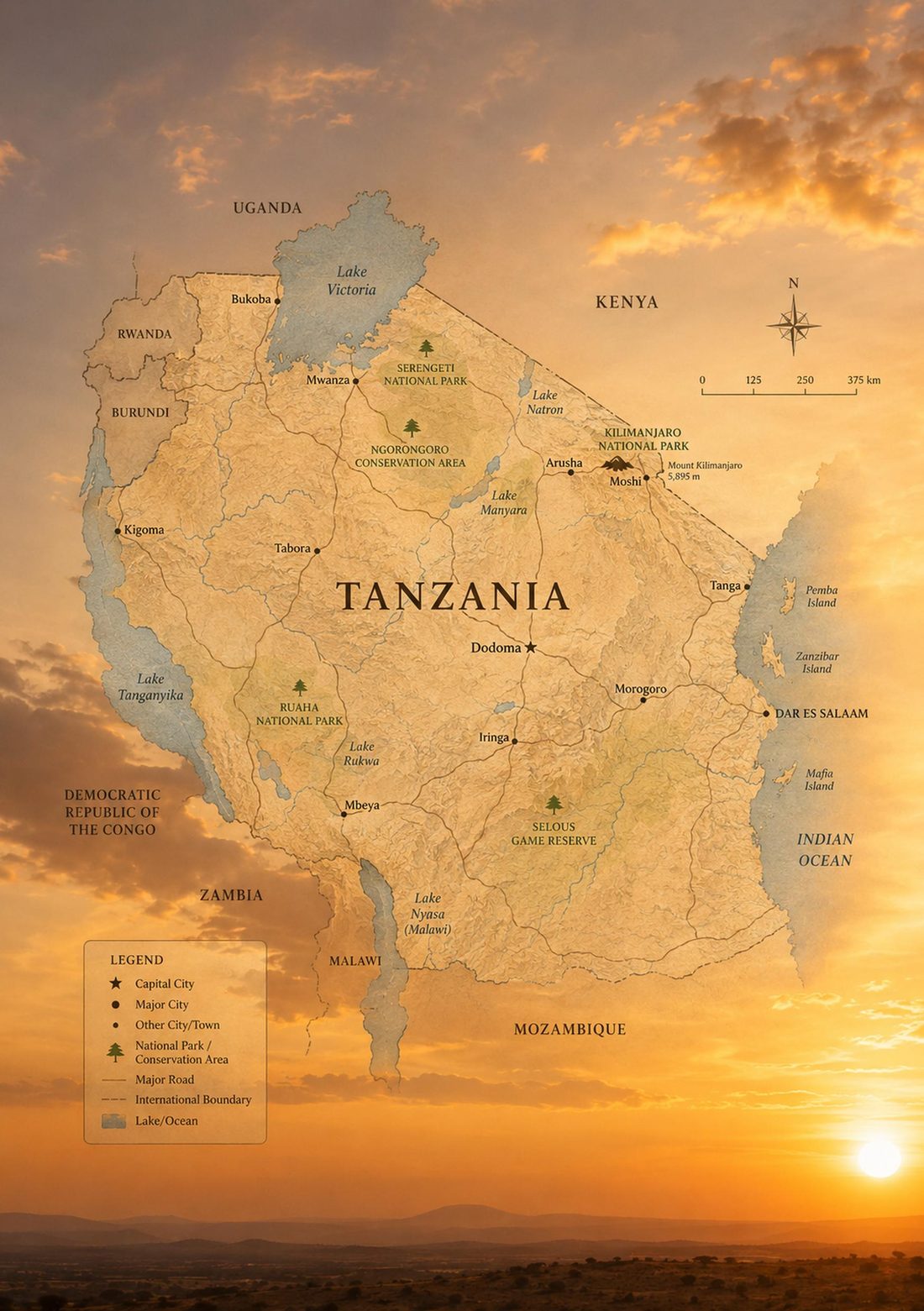
To the north: Kilimanjaro (5,895 m) and Meru (4,562 m), both visible from Arusha on a clear morning. To the west: Lake Victoria, source of the White Nile and the second-largest freshwater lake on the planet. To the east: the Indian Ocean and the Zanzibar archipelago — Unguja (the main island, where we land), Pemba, and Mafia.

The Northern Circuit we’ll travel — Tarangire, Manyara, Serengeti, Ngorongoro — is a single connected ecosystem. Animals don’t recognise the park borders; the whole thing flows.

People

Around 65 million people. 120+ ethnic groups — Sukuma, Chagga, Haya, Maasai, Hadza, Iraqw, Nyamwezi, and many more — none of which forms a majority. This is unusual on the continent and is part of why Tanzania has been comparatively peaceful since independence.

The Hadza, near Lake Eyasi, are one of the last hunter-gatherer peoples on Earth, with a click-language unrelated to any other. The Maasai are the iconic pastoralists — we’ll spend time in a manyatta on Day 6 of the safari. The Chagga live on the slopes of Kilimanjaro and were the first in Tanzania to plant coffee — we’ll meet a Chagga coffee family on the Materuni day.

Languages

Swahili (Kiswahili) is the national lingua franca and a unifier — a Bantu base braided with Arabic, Persian, Portuguese and English loanwords from a thousand years of Indian-Ocean trade. Roughly 80 % of Tanzanians speak it; many also speak their ethnic mother tongue at home.

English is the second official language and the language of higher education, government and business. Most people we’ll meet on the trip will speak it. Try Swahili anyway — you’ll be rewarded.

Religion

Mainland Tanzania is roughly half Christian, a third Muslim, and the rest indigenous beliefs — and most communities have all three woven through them. Zanzibar is ~98 % Muslim, a legacy of the 7th-century Swahili coast and the long Omani sultanate.

What this means for us: in Stone Town, dress modestly (shoulders & knees covered, beachwear stays at the beach). The call to prayer at dawn is one of the most beautiful things you’ll hear there.

Climate

Equatorial — warm year-round at sea level, cool in the highlands. Late June to early July is the heart of the long dry season: bright days, cool nights, thin red dust. Temperatures we should expect:

  • Zanzibar: 22–30 °C, dry, breezy
  • Arusha / Tarangire: 12–26 °C, dry
  • Serengeti: 11–25 °C, dust on the wind
  • Ngorongoro rim: 5–20 °C — gets cold at night, plan for it

The political layer

Tanzania is a presidential republic, the dominant party is CCM (Chama cha Mapinduzi, Party of the Revolution). The country was forged from the 1964 union of Tanganyika (mainland) and Zanzibar (the islands) — Zanzibar still has its own president and parliament alongside the union government. The current president, Samia Suluhu Hassan, took office in 2021 and is the first woman to hold the role.

06 — How we got here

A short history of Tanzania

From the Cradle of Humankind to a 1960s socialist experiment to today. Most of the world’s human story passed through here first.

  1. 3.6 m yrs ago

    Footprints at Laetoli

    In 1976, paleontologist Mary Leakey uncovered a trail of hominin footprints preserved in volcanic ash near the Ngorongoro region. Three individuals — possibly Australopithecus afarensis, the species of Lucy — walked upright across wet ash, and the rain that followed sealed it. They are among the oldest direct evidence of bipedal walking we have. Tanzania’s Olduvai Gorge, also in the area, gave us some of the earliest stone tools.

  2. ~ 1000 BCE → 500 CE

    Bantu expansion & ironworking

    Bantu-speaking farmers move down from the West African / Cameroonian region across the centuries, bringing iron-smelting, cattle, and the linguistic root that will eventually become Swahili. By the first centuries CE, ironworking villages line the Great Lakes.

  3. 7th — 15th c.

    The Swahili Coast

    From the 700s onwards, an extraordinary trading civilisation grew along the East African coast — Mogadishu down to Kilwa, with Zanzibar and Pemba in the middle. Bantu-speaking coastal peoples mixed with Arab, Persian and later Indian merchants. The result was the Swahili identity: a lingua franca, a coastal Islam, coral-stone architecture, ocean-going dhows.

    Kilwa Kisiwani, south of today’s Dar es Salaam, was once the wealthiest city on the African coast — Ibn Battuta visited in 1331 and called it “one of the most beautiful and well-constructed towns in the world.”

  4. 1498 — 1700s

    Portuguese, then Omani

    Vasco da Gama rounded the Cape in 1498. Within a generation, Portugal controlled the coast brutally. The Omani Arabs, allied with the coastal Swahili, drove them out by 1698. In 1840 the Omani sultan moved his capital from Muscat to Stone Town — a decision that would shape Zanzibar more than any other.

    Under Omani rule, Zanzibar became a major hub for cloves (still grown today on Pemba) — and, devastatingly, for the East African slave trade. The slave market in Stone Town operated until 1873; the Anglican Cathedral we’ll visit was deliberately built on its site.

  5. 1885 — 1919

    German East Africa

    At the Berlin Conference, the European powers carve up the continent on paper. Germany takes the mainland and calls it Deutsch-Ostafrika. Their rule is harsh; the Maji Maji rebellion (1905–1907) is one of the largest African uprisings against colonial rule, and is suppressed at the cost of perhaps 300,000 lives. After Germany’s defeat in WWI, the territory is handed to Britain as a League of Nations mandate and becomes Tanganyika.

  6. 1961 — 1964

    Independence & union

    On 9 December 1961, Tanganyika gains independence under Julius Nyerere, a former teacher with a degree from Edinburgh and a vision of African socialism. Zanzibar becomes independent in December 1963; a violent revolution in January 1964 overthrows the Sultan. In April 1964, Tanganyika and Zanzibar merge to form the United Republic of Tanzania — a portmanteau.

  7. 1967 — 1985

    Ujamaa & Nyerere

    Nyerere — known as Mwalimu, the teacher — launches the Ujamaa programme: a vision of village-based African socialism. It nationalises industry, collectivises agriculture, builds schools and clinics. Literacy rises sharply. The economy stalls. Today Nyerere is remembered with deep affection for his integrity and his role in shaping a unified national identity in a country with 120 ethnic groups — even as the economic experiment is judged to have failed. He stepped down voluntarily in 1985.

  8. 1990s — today

    Liberalisation & quiet rise

    From the early 1990s the country liberalises, multi-party politics returns, tourism grows, mining and gas come online. Tanzania has remained politically stable and largely peaceful — a striking achievement in the region. President Samia Suluhu Hassan, in office since 2021, is the country’s first female head of state and a Zanzibari Muslim leading a majority-Christian mainland coalition.

07 — Things to eat

What to eat in Tanzania

Two food cultures, really: the mainland (ugali, beans, grilled meat, sukuma) and the spice-tangled coast (biryani, coconut curries, the night markets of Stone Town).

Ugali staple

A stiff porridge of maize flour and water, the daily staple. Eaten with the right hand: pinch a ball, dent it with your thumb, scoop the stew. Plain on its own — it’s the canvas, not the painting.

Nyama choma grilled meat

Goat or beef grilled over charcoal, sliced thin, served with a heap of salt and chillies and a pile of kachumbari — chopped tomato, onion, lime, coriander. The single most beloved meal in the country. Eat it at a roadside place with plastic chairs.

Biryani Zanzibar

Persian-via-Mughal-via-Swahili rice dish, layered with cardamom, cloves, saffron, and spice-rubbed meat. The Zanzibar version is often slow-cooked with potato. Try it at Lukmaan in Stone Town.

Pilau spiced rice

Pilaf cousin of biryani, but cooked together in one pot rather than layered. Cumin, cinnamon, cloves, peppercorns. Served at every celebration.

Mishkaki skewers

Small kebabs of marinated beef, goat or chicken, grilled over coals. Street food, late afternoon, with a squeeze of lime.

Chapati flatbread

The Indian-Tanzanian flatbread, flaky and oily, descended from a century of South-Asian migration to East Africa. Tear pieces and dip in stew or eat for breakfast with chai.

Mandazi breakfast

Slightly sweet fried dough, lightly cardamom-scented. Triangular. Best with sweet milky chai in the morning. The Swahili doughnut.

Wali wa nazi coconut rice

Rice cooked in coconut milk — fragrant, faintly sweet. A coastal staple, often paired with samaki wa kupaka.

Samaki wa kupaka coastal

Whole reef fish marinated, grilled, then bathed in a coconut-tamarind curry. Zanzibari signature. Order it at any beach restaurant.

Urojo Stone Town

Also called Zanzibar mix — a tangy turmeric-tamarind soup with bhajia, boiled potato, kachori, crisp noodles, coconut chutney. A whole micro-cuisine in a paper bowl.

Forodhani Gardens night market

Every evening at the Stone Town waterfront, lantern-lit stalls grill seafood, lobster, octopus, “Zanzibar pizza” (a stuffed crepe of egg, cheese, mince, mayo — somehow it works). Go hungry. Bring small TSH notes.

Mbuzi choma goat

Roast goat — a celebration meal, especially at the Maasai village where we’ll likely eat some. Slow-cooked over an open fire, served with ugali.

Sukuma wiki greens

“Stretches the week.” Collard greens braised with onion, tomato, sometimes peanut. The everyday vegetable side; what gets ugali through Wednesday.

Coffee Chagga / Materuni

Tanzanian arabica from the slopes of Kilimanjaro and Mount Meru — bright, peachy, floral. We’ll watch a Chagga family go from cherry → bean → cup on the Materuni day. Buy a kilo to bring home.

Kahawa & chai

Strong unsweetened black coffee in tiny cups, often spiced with ginger and cardamom — sold at street corners from copper kettles. Chai is sweet milky tea, also spiced. The two daily punctuations.

Konyagi & Kilimanjaro drinks

Kilimanjaro and Serengeti are the local lagers, light and cold. Konyagi is the national gin-adjacent spirit, drink it with a wedge of lime. Stoney Tangawizi (ginger beer) is the soft drink to know.
08 — Stories told around fires

Folk tales

Three tales from the oral tradition. Across most of East Africa, folk stories begin with a call: “Hadithi! Hadithi!” — “Story! Story!” And the listeners answer: “Hadithi njoo!” — “Let it come.”

Hare cycle

Sungura and the well

In the great drought, all the animals agreed to dig a well together. All except Sungura the Hare, who told them he was too clever to dig and would find his own water somewhere. The animals dug. The well was deep and full.

Each morning the animals drank, and each night, when they slept, Sungura crept down and drank his fill. The lion was furious. Hyena was set to guard the well; Hare distracted him with a song about honey, and slipped past. Leopard was set to guard it; Hare brought him a pot of palm wine, and he fell asleep. Tortoise was set to guard it last — slow, quiet, patient. Tortoise hid in the mud at the well’s edge.

When Hare came in the moonlight, Tortoise grabbed his foot. Hare laughed and said, “Old Tortoise, are you really trying to hold me, the swiftest animal? Squeeze harder, I dare you.” Tortoise squeezed harder. Hare howled. The animals came running.

— and that is why even the cleverest gets caught by the patient one in the end.

Maasai · oltatua

Why the sun and moon walk apart

The Maasai say Engai, the god, made the sun and the moon as husband and wife. They walked together across the sky and the earth was never dark. But one day they quarrelled, and they fought.

The sun, in his anger, struck the moon and bruised her face — that is why, even now, you can see the dark patches on her cheek. The moon, in her grief, scratched the face of the sun — and that is why if you try to look directly at him, your eyes water and burn, because his face is too bright with the wound.

From that day they walked apart. The sun travels by day with all his pride, and the moon travels by night with her quiet face turned away. And only at the eclipse do they pass close enough to see each other again.

— the Maasai tell this one looking up; the night sky is the page.

Swahili coast

The fisherman and the jinn

An old fisherman of Stone Town cast his net for three days and pulled up nothing. On the fourth day his net came up heavy. Inside was a copper jar, sealed with the seal of Suleiman.

He pried the seal. A jinn, vast as smoke, rose into the harbour sky. “For the first hundred years of my prison,” said the jinn, “I swore to make rich whoever freed me. For the second hundred, I swore to give him three wishes. For the third, I swore to grant him a kingdom. But by the fourth, I swore to kill the man who freed me — and you are he.”

The fisherman thought a moment. “Truly, you are a great jinn,” he said. “But I cannot believe such a giant came from such a small jar. Show me how you fit, and then kill me.”

The jinn, vain, condensed back into smoke and slid into the jar. The fisherman snapped the seal back on, threw it into the sea, and went home for chai.

— the version Scheherazade told on night three. The Swahili coast has been remixing it since.

09 — Karibu

A small Swahili kit

Tanzanians light up when foreigners try. Five minutes of effort here will buy you a thousand smiles. Pole pole — slowly, slowly. Pronunciation tip: every vowel is sounded, stress almost always on the second-to-last syllable. Karibu = ka-RI-bu.

Greetings & basics

  • Jambo JAM-bo — Hello (tourist version)
  • Habari? ha-BA-ri — How are you? (lit. news?)
  • Nzuri n-ZU-ri — Good / fine (the answer)
  • Mambo? MAM-bo — What’s up? (casual)
  • Poa PO-a — Cool (the answer to mambo)
  • Karibu ka-RI-bu — Welcome / you’re welcome
  • Asante (sana) a-SAN-te — Thank you (very much)
  • Tafadhali ta-fa-THA-li — Please
  • Samahani sa-ma-HA-ni — Excuse me / sorry
  • Ndiyo / Hapana — Yes / No
  • Kwaheri kwa-HE-ri — Goodbye
  • Hakuna matata — No problem (yes, that one — it’s real)

Polite to elders

  • Shikamoo shee-ka-MO-o — Respectful greeting to anyone older than you (elders, hosts, parents)
  • Marahaba ma-ra-HA-ba — The reply (only an elder says this back)

If a child says shikamoo to you, it’s a compliment and a small responsibility — answer warmly with marahaba.

Numbers

  • moja — 1
  • mbili — 2
  • tatu — 3
  • nne — 4
  • tano — 5
  • sita — 6
  • saba — 7
  • nane — 8
  • tisa — 9
  • kumi — 10
  • ishirini — 20
  • mia — 100

Out & about

  • Bei gani? — How much?
  • Ghali sana — Too expensive (start of a friendly negotiation)
  • Punguza bei — Lower the price
  • Choo kiko wapi? — Where is the toilet?
  • Nataka… — I want…
  • Sielewi — I don’t understand
  • Maji — water · chakula — food · bia — beer · kahawa — coffee · chai — tea
  • Pole pole — slowly, slowly (the unofficial national motto)
  • Twende! — Let’s go!

On safari

  • Simba — lion · Chui — leopard · Tembo / Ndovu — elephant
  • Faru — rhino · Nyati — buffalo · Duma — cheetah
  • Twiga — giraffe · Punda milia — zebra · Kiboko — hippo
  • Fisi — hyena · Mamba — crocodile · Nyumbu — wildebeest
  • Ndege — bird (also: aeroplane)
10 — What goes in

Packing list

Tick as you pack. State is saved in your browser, so come back to it. Soft duffel for the safari portion — not a hard suitcase; the jeeps don’t love them.

Documents (carry-on)

Clothing — safari

Avoid black & navy — they attract tsetse flies. Avoid bright colours — they spook wildlife. Neutral wins.

Clothing — Zanzibar

Health & toiletries

Tech & camera

The little things

11 — Body & wallet

Health, money & small things

The handful of practical things that keep a trip on the rails.

Vaccines

  • Yellow fever — required to enter Tanzania only if arriving from a YF-endemic country. Some airlines check in transit; carry your certificate either way.
  • Routine boosters — tetanus, MMR, polio, hepatitis A, typhoid (recommended).
  • Hepatitis B, rabies — consider, especially if you’ll be on extended trips.
  • Cholera — usually only for outbreak areas; check your travel-clinic guidance.
  • See your travel clinic 6+ weeks before departure.

Malaria

  • Tanzania has malaria year-round below ~1,800 m. Both Zanzibar and the safari areas are at risk.
  • Take a prophylactic — typically Malarone (atovaquone-proguanil), doxycycline, or mefloquine. Discuss with your GP / travel clinic.
  • Best prevention is bite prevention: long sleeves at dusk, DEET 30 %+, sleep under nets (camps provide them).
  • If you develop fever 1 week → 1 year after return: tell the doctor you were in a malaria zone.

Water & food

  • Don’t drink the tap water — bottled or filtered only. Camps provide drinking water.
  • Be careful with ice and salads in cheap places. Stone Town and the camps are generally fine.
  • Street food: pick busy stalls with high turnover, food cooked in front of you.
  • Carry rehydration salts. The dust + heat sneaks up on you.

Money

  • Currency: Tanzanian Shilling (TSH). ~2,500 TSH ≈ 1 USD (verify before departure).
  • USD is widely accepted in tourism. Bring post-2009 bills, crisp, no marks — older notes are often refused.
  • ATMs in Arusha & Stone Town dispense TSH. Visa is most reliable; bring a Mastercard backup.
  • Notify your bank of travel dates.
  • Most safari operators take USD or card for extras.

Tipping

  • Safari guide: ~$10 / person / day. The single biggest tip — they make the trip.
  • Cook on camping nights: ~$5 / person / day.
  • Lodge / camp staff: $1–2 in the communal tip box.
  • Restaurant: 5–10 % if not already on the bill.
  • Porters / drivers: $1–2 per bag / leg.
  • Hand the safari tips to the lead guide on the last day in an envelope.

Power & connectivity

  • Plug type G (UK three-pin), 230 V / 50 Hz. Bring 2 adapters minimum.
  • Lodges have power; bush camps may only run a generator at meal hours. Charge whenever you can.
  • Vodacom / Airtel SIM at the airport (~$10 for a fat data bundle, passport required).
  • Wi-Fi: yes in Stone Town and Furaha; effectively no in Serengeti / Ngorongoro Simba.

Safety

  • Tanzania is one of the safer countries in East Africa for travellers. Stone Town & Arusha are generally fine; usual urban awareness applies.
  • Don’t flash valuables; use the hotel safe; carry only the day’s cash.
  • On safari you are completely safe in the vehicle; outside it, listen to your guide. The Big Five are not pets.
  • The night drive in Lake Manyara & the Ngorongoro rim camp are both safe with the operator’s rangers — but heed instructions about staying in tents after dark.

Photography etiquette

  • Always ask before photographing people, especially Maasai. A small tip is appreciated and customary in arranged village visits.
  • Don’t photograph government buildings, soldiers, police, airports — even casually.
  • Slow down on safari — the temptation is to shoot everything. Sometimes putting the camera down is the better memory.